Dinosaur Watercolor: Playful & Professional Design
Watercolor has long held a quiet power in design—soft edges, organic texture, and subtle transparency that digital brushes often struggle to replicate authentically. When that watercolor technique meets the joyful, timeless appeal of dinosaurs, something special happens: Dinosaur Watercolor becomes more than a motif. It’s a versatile, emotionally resonant visual language—one that bridges nostalgia and modern craft sensibility.
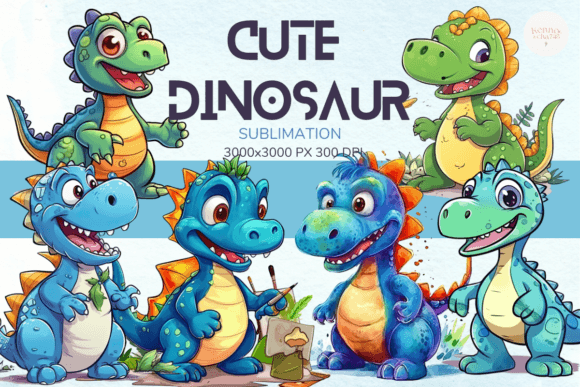
This collection delivers six individual PNG images—each hand-rendered in rich watercolor style, then digitally refined for clarity and consistency. They arrive at 3000×3000 px, 300dpi, with fully transparent backgrounds. No clipping masks, no guesswork—just ready-to-use assets built for real creative workflows.
Why Dinosaur Watercolor Works Across Audiences
Dinosaurs carry broad emotional resonance: curiosity for educators, whimsy for party planners, boldness for branding designers, and gentle charm for stationery makers. Paired with watercolor’s natural imperfection, they avoid feeling cartoonish or juvenile—instead landing as warm, intelligent, and intentionally crafted.
That balance makes Dinosaur Watercolor uniquely adaptable. A kindergarten teacher can print one onto name tags for the first day of school—soft enough to calm anxiety, distinctive enough to spark conversation. A small-batch jewelry maker can resize and layer it onto resin pendants, letting the pigment bleed subtly at the edges. A wedding stationer might use the same image as a delicate watermark behind elegant serif type on an invitation suite—adding personality without competing with hierarchy.
Practical Uses You Can Start Today
These aren’t just “cute graphics.” They’re production-ready components designed for integration into physical and digital outputs alike:
- Scrapbooking & Journaling: Print at 50–70% scale on cardstock, cut out with precision scissors or a die-cut machine, and layer over handwritten notes or photo corners. The transparency lets underlying textures—kraft paper, linen, or washi tape—show through naturally.
- Handmade Stationery: Import into Canva or Affinity Designer, adjust hue/saturation to match your brand palette (try muted sage + terracotta), then apply to thank-you cards, notepads, or sticker sheets. Because each file is high-res and transparent, resizing won’t introduce pixelation—even when printed at 4×6” or scaled down to 1” icons.
- Sublimation & Fabric Projects: Use directly in sublimation software for tote bags, kids’ backpacks, or classroom aprons. Watercolor’s soft gradients translate beautifully to polyester blends, avoiding harsh halos or banding common with vector-based art.
- Hardcover Book Covers & Journals: Align one centered on a 6×9” cover template, add foil-stamped title text, and send to print. The watercolor texture adds tactile depth even before embossing or spot UV is applied.
- Decoupage & Furniture Detailing: Print on decal paper or Mod Podge transfer sheets. Apply to wooden pencil holders, ceramic mugs, or drawer fronts—the pigment variation reads as intentional craftsmanship, not digital repetition.
How Different Creators Can Adapt Them Strategically
Educators and Homeschoolers: Use one dinosaur per learning unit—pair a stegosaurus with a geology lesson, a pterodactyl with flight physics. Print full-size on matte photo paper, laminate, and hang as visual anchors in learning spaces. The watercolor aesthetic signals approachability, helping students engage without intimidation.
Small Business Owners (especially gift shops, craft studios, or children’s boutiques): Bundle three images into a printable “Dino Discovery Kit”—include coloring pages, simple origami folds, and a matching word search. Offer it as a free download in exchange for email sign-ups. The consistent watercolor style builds recognizable brand texture across touchpoints.
Bloggers & Content Creators: Feature one image per seasonal post—“Dino-Themed Back-to-School Prep,” “Paleontology-Inspired Fall Craft Ideas,” or “Watercolor Dinosaurs in Nature Journaling.” Embed the PNG at 800px wide in articles; link to your shop or resource library. Google rewards original, context-rich visual usage—especially when paired with clear, practical writing.
Freelance Designers & Print-on-Demand Sellers: Layer these over textured backgrounds (concrete, handmade paper, linen) in Photoshop using Multiply or Overlay blend modes. Export as mockups for Etsy listings—customers respond to realism and cohesion, not isolated clipart.
Maintaining Clarity and Consistency
Even playful assets benefit from intentionality. To keep your projects effective and audience-friendly:
- Limit color shifts. Adjust only hue and lightness—not saturation—to preserve the watercolor’s natural grain. Over-saturating flattens texture; desaturating too far turns it muddy.
- Respect negative space. These images breathe best when given room. Avoid cramming multiple dinos onto a single tag or place card—choose one focal point and let it anchor the composition.
- Match scale to function. A 3000×3000 px file gives flexibility—but don’t default to full size. For packaging labels, 600–1200 px width often provides optimal legibility and print fidelity.
- Test physical output early. Print one image on your intended paper stock (e.g., 110 lb cover vs. kraft cardstock) before batching. Watercolor behaves differently across absorbency levels—and what looks vibrant on screen may soften pleasingly—or disappear—on uncoated surfaces.
Real Projects, Real Results
A Brooklyn-based educator used one of these watercolor dinos as the central graphic on her classroom’s “Science Explorer” badge system—students earned laminated badges tied to observation skills, hypothesis building, and collaborative inquiry. The soft edges made them feel inclusive, not competitive.
A Portland stationery brand incorporated two variants into their “Back to School” line: one as a subtle background repeat on notebook interiors, another enlarged and foil-stamped on hardcover journals. Both shared the same color family (warm ochre + deep indigo), creating cross-product recognition without repetition.
A freelance illustrator licensed the set for a limited-run series of enamel pins—resizing each dino to fit 1.25” circular dies, then working with the manufacturer to preserve edge softness in the final metal fill. The result? Collectible, tactile pieces that felt handmade—not mass-produced.
None of these outcomes required complex tools or advanced skills. They began with selecting the right image, understanding its texture and scale, and applying it where it supported—not overshadowed—the user’s goal.
That’s the quiet strength of Dinosaur Watercolor: it doesn’t demand attention. It earns it—through thoughtful application, consistent quality, and respect for both the medium and the maker.