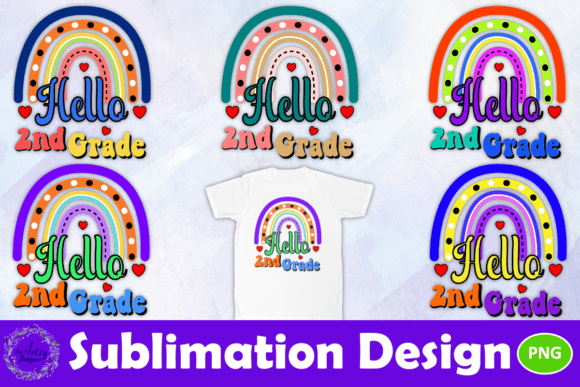
Hello 2nd Grade Rainbow Sublimation PNG: A Practical Guide for Educators, Makers, and Small-Business Creators
For educators preparing classroom welcome materials, small-business owners launching back-to-school merchandise lines, or crafters designing personalized teacher appreciation gifts, the Hello 2nd Grade Rainbow Sublimation PNG bundle offers more than just cheerful visuals—it delivers functional digital assets engineered for real-world production. Unlike generic clipart, this curated set bridges pedagogical warmth with technical readiness, making it a quietly powerful tool in both educational and entrepreneurial contexts.
Why Resolution and Transparency Matter—Beyond Aesthetics
The technical specifications embedded in this bundle—4500 × 5064 pixels at 300 dpi, transparent background, PNG format—are not arbitrary. They reflect deliberate alignment with industry-standard sublimation workflows. For example, a 15 × 16 inch canvas at 300 dpi ensures crisp output on large-format items like tote bags or classroom banners, where pixelation would undermine professionalism. The absence of white or colored backgrounds eliminates post-processing steps: no need to manually erase edges in Photoshop or wrestle with anti-aliasing artifacts when layering over textured fabrics or gradient mug surfaces.
This level of technical fidelity is especially valuable for educators who lack design training but need reliable results. A second-grade teacher printing class T-shirts for an “All About Me” unit can drag-and-drop a Hello 2nd Grade Rainbow Sublimation PNG file directly into Cricut Design Space (using the Print Then Cut workflow) or upload it to a print-on-demand platform like Printful—no intermediate editing required. Similarly, a small-batch apparel entrepreneur sourcing blanks from Bella+Canvas or Gildan can scale the same file across multiple SKUs without reworking proportions or losing clarity.
Use Cases Rooted in Real Educational and Creative Workflows
Applications extend far beyond surface-level decoration. Each of the five designs functions as a modular component within broader communication strategies:
- Classroom Identity Systems: Teachers often build cohesive visual language across name tags, bulletin boards, digital newsletters, and parent handouts. Using one consistent Hello 2nd Grade Rainbow Sublimation PNG variant across these touchpoints reinforces belonging and reduces cognitive load for young learners navigating new routines.
- Student-Centered Craft Integration: While the files themselves are digital, they serve as springboards for analog learning. A teacher might project one rainbow design, then guide students in recreating its color sequence using watercolors—linking digital literacy with hands-on art standards. Or, printed at reduced size, the graphics become cut-out elements for collaborative storyboards about community or growth.
- Teacher Wellness & Recognition Tools: The emotional resonance of rainbows—hope, diversity, transition—pairs meaningfully with the milestone of entering second grade. That makes these illustrations effective in low-stakes wellness initiatives: coffee mugs for staff lounge swaps, laminated “You’ve Got This!” cards slipped into lesson plan binders, or printable bookmarks for professional development book studies.
- Small-Business Product Diversification: For makers selling on Etsy or local craft fairs, bundling physical items with matching digital downloads increases perceived value. A customer purchasing a “Hello 2nd Grade” canvas tote could also receive a ZIP file containing the same artwork—allowing them to personalize matching notebooks or stickers at home. This cross-channel utility strengthens brand consistency and repeat engagement.
Design Integrity in Practice: What “Rainbow” Really Communicates
The rainbow motif here operates on multiple levels. Visually, it signals joy and inclusivity—qualities central to early elementary environments. Structurally, its arc provides natural hierarchy: text flows along the curve, guiding the eye without competing with background elements. Color distribution isn’t random; each variant balances saturation and contrast so that “Hello 2nd Grade” remains legible even when overlaid on busy patterns (e.g., polka-dot mugs or plaid fabric).
Importantly, the palette avoids overly neon or fluorescent tones that risk printing inaccuracies. Instead, the colors fall within sRGB gamut boundaries commonly supported by dye-sublimation printers and commercial inkjet systems—reducing the likelihood of unexpected shifts between screen and final product. That said, the disclaimer about device and printer variance is essential: a monitor calibrated for photography will render cerulean differently than a budget laptop screen, and cotton-polyester blends absorb sublimation dyes more vibrantly than 100% cotton. Testing one file on a sample blank before full production remains best practice.
Workflow Integration Across Platforms and Skill Levels
No single software dominates the ecosystem where these files live. Their utility emerges precisely because they’re format-agnostic:
- Sublimation-Specific Tools: In Sawgrass Creative Studio or ChromaBlast Designer, users can apply halftone filters or adjust gamma settings to optimize for specific press temperatures—without altering the base PNG’s integrity.
- Vector-Based Environments: Though the files are raster-based, designers using Adobe Illustrator or Affinity Designer can place them as embedded links, then use Image Trace (with high-fidelity settings) to generate scalable outlines if needed for embroidery digitizing or vinyl cutting—though the original bundle excludes cutting files, as noted.
- Education-Focused Platforms: Google Slides and Canva accept PNG uploads natively. A school media specialist creating a “Welcome Back” slideshow can insert the graphic, resize it responsively, and export individual slides as JPEGs for printing—no licensing concerns, since the bundle permits commercial and personal use.
- Low-Tech Adaptations: Even without digital tools, the high-resolution files support analog reproduction. Printing at 50% scale yields sharp 7.5 × 8 inch images ideal for laminated center signs or student-made greeting cards—demonstrating how digital assets can feed tactile learning experiences.
Strategic Considerations for Ethical and Effective Use
While the bundle enables speed and consistency, thoughtful implementation prevents visual fatigue or unintended messaging. Overusing identical rainbows across every classroom surface may dilute their impact—or worse, inadvertently signal rigidity in an environment meant to celebrate individuality. Consider rotating variants: one design for hallway displays, another for digital communications, a third reserved exclusively for student-facing materials.
Also worth noting: the absence of cutting files isn’t a limitation but a boundary. It clarifies scope—this is a sublimation-first resource, not a hybrid craft kit. Users seeking SVG compatibility for Cricut Explore or Silhouette Cameo should source complementary assets separately rather than force conversions that degrade quality.
Finally, accessibility matters. When applying these graphics to digital platforms, ensure sufficient contrast between text and any underlying background—even if the PNG itself has transparency. For instance, placing “Hello 2nd Grade” over a light-yellow gradient requires verifying that the rainbow’s violet segment meets WCAG 2.1 AA contrast ratios against that hue. Built-in tools in Figma or browser extensions like axe DevTools can verify compliance quickly.
Connecting to Broader Trends in Educational Design
The rise of such bundles reflects deeper shifts in how schools and creators approach visual communication. There’s growing recognition that design isn’t peripheral—it’s pedagogical. Welcoming visuals reduce anxiety for neurodiverse learners; consistent branding builds institutional memory across grade levels; and student-co-created materials (using templates derived from resources like this) foster agency and ownership.
Moreover, the demand for ready-to-use, ethically licensed assets mirrors trends in open educational resources (OER). Just as teachers curate free lesson plans from trusted repositories, they now seek trustworthy digital components—free from attribution clutter, hidden fees, or murky usage terms. The Hello 2nd Grade Rainbow Sublimation PNG bundle succeeds because it meets those expectations: clarity in licensing, precision in execution, and relevance in application.
In essence, this isn’t merely clipart. It’s infrastructure—quietly enabling better teaching, more intentional making, and more inclusive celebrations of learning milestones. Whether you’re pressing a mug for your co-teacher, designing a welcome banner for your school’s front entrance, or prototyping a new line of classroom supplies, the value lies not in the rainbow itself, but in how reliably it carries meaning across mediums, audiences, and intentions.